
Hydroxyethyl Cellulose (HEC)
LANDERCOLL® hydroxyethyl cellulose (HEC) is a nonionic, water-soluble cellulose ether used to control aqueous-phase viscosity in architectural paints, waterborne coatings and selected liquid formulations. Compare published grades, understand application rheology and request the technical documents needed to qualify a suitable product.
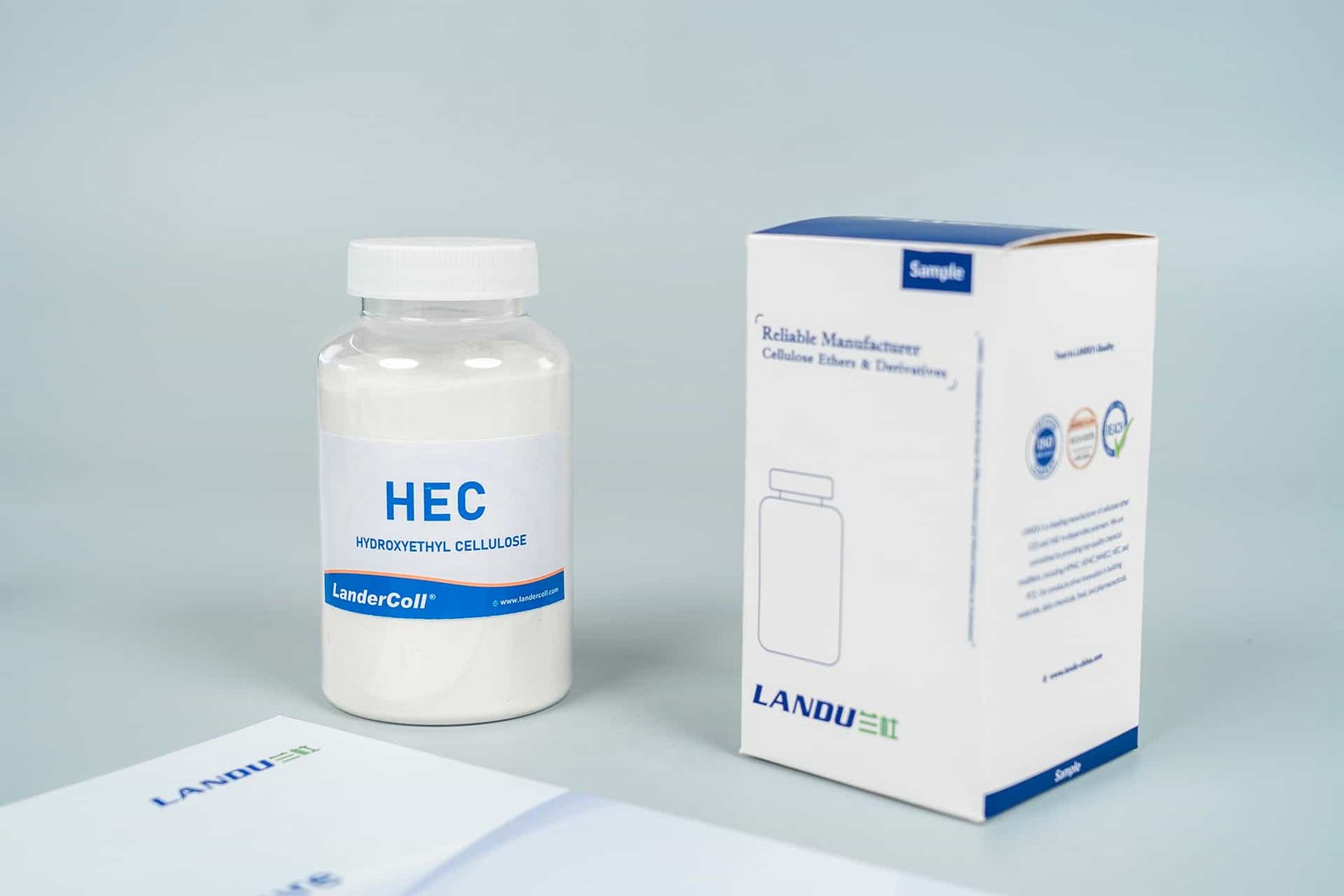
Water-based formulation materials
HEC Product Identity & Published Grade Reference
Identify the polymer first, then compare its viscosity under stated preparation and measurement conditions. HEC is hydroxyethyl-substituted cellulose (CAS 9004-62-0), not an interchangeable label for HPMC, HEMC/MHEC or sodium carboxymethyl cellulose (CMC).
HE30M — Reference Technical Values
- Appearance
- White or milky-white, free-flowing powder
- Moisture content
- ≤6%
- Ash content
- ≤5%
- Density
- 300–600 kg/m³
- pH
- 6–8
- Particle size
- ≥95% passing 80 mesh
- Brookfield RV viscosity
- 1,500–2,500 mPa·s (1% solution)
- Reported dissolution time
- Approx. 30 minutes
- Delayed solubility
- Listed as available
HE30M values reflect the existing LANDU product reference. They are not a batch CoA or a substitute for the currently approved TDS. The source does not specify all viscosity test conditions, and dissolution time is process-dependent; confirm temperature, hydration time, spindle and rotational speed before acceptance.
Compare the same test conditions before choosing a grade
A single Brookfield figure is a solution-viscosity reference, not a prediction of finished-paint flow. The series listed below include readings at 1% and 2%; concentrations, temperature, sample preparation and instrument settings must match before values can be compared meaningfully.
- Request the current grade-specific TDS and SDS.
- Confirm instrument, concentration, temperature and test settings.
- Match the grade's hydration behavior to your production sequence.
- Request batch CoA requirements before commercial approval.
LANDERCOLL® HEC Grades: Standard, Biostability-Oriented & Modified
Use the LANDU grade names and viscosity reference ranges below to build a shortlist. HE is presented as standard HEC, HE-BE as a biostability-oriented line, and MEB as hydrophobically modified HEC. Exact grade chemistry, surface treatment, viscosity method and availability must be confirmed from current technical documentation.
| LANDU Grade | Published family | Brookfield, 2% (mPa·s) | Brookfield, 1% (mPa·s) | Documentation |
|---|---|---|---|---|
| HE15M | Standard HEC · HE | — | 800–1,500 | Request TDS |
| HE30M | Standard HEC · HE | — | 1,500–2,500 | Request TDS |
| HE30MX | Standard HEC · HE | — | 1,500–2,500 | Request TDS |
| HE60M | Standard HEC · HE | — | 2,500–3,500 | Request TDS |
| HE100M | Standard HEC · HE | — | 3,500–5,000 | Request TDS |
| HE200M | Standard HEC · HE | — | 6,000–8,000 | Request TDS |
| HEC LR | Biostability-oriented HEC · HE-BE | 7–15 | — | Request TDS |
| HEC ER | Biostability-oriented HEC · HE-BE | 80–150 | — | Request TDS |
| HEC GR | Biostability-oriented HEC · HE-BE | 250–400 | — | Request TDS |
| HE2MBE | Biostability-oriented HEC · HE-BE | 1,500–2,500 | — | Request TDS |
| HE5MBE | Biostability-oriented HEC · HE-BE | 4,500–6,500 | — | Request TDS |
| HE15MBE | Biostability-oriented HEC · HE-BE | — | 800–1,500 | Request TDS |
| HE30MBE | Biostability-oriented HEC · HE-BE | — | 1,500–2,500 | Request TDS |
| HE60MBE | Biostability-oriented HEC · HE-BE | — | 2,500–3,500 | Request TDS |
| HE100MBE | Biostability-oriented HEC · HE-BE | — | 3,500–5,000 | Request TDS |
| MEB4M | Modified HEC · MEB | 3,000–5,000 | — | Request TDS |
| MEB15M | Modified HEC · MEB | — | 800–1,500 | Request TDS |
| MEB30M | Modified HEC · MEB | — | 1,500–2,500 | Request TDS |
| MEB60M | Modified HEC · MEB | — | 2,500–3,500 | Request TDS |
| MEB80M | Modified HEC · MEB | — | 3,000–4,000 | Request TDS |
| MEB100M | Modified HEC · MEB | — | 3,500–5,000 | Request TDS |
| MEB5500 | Modified HEC · MEB | — | 5,000–7,000 | Request TDS |
| MEB7000 | Modified HEC · MEB | — | 6,000–8,000 | Request TDS |
| MEB8000 | Modified HEC · MEB | — | 7,000–9,000 | Request TDS |
| MEB10000 | Modified HEC · MEB | — | 9,000–12,000 | Request TDS |
Showing all 25 listed HEC and modified HEC reference grades.

How HEC Influences Waterborne Formulations
HEC is produced by introducing hydroxyethyl groups onto a cellulose backbone. When dispersed and fully hydrated in water, dissolved polymer chains increase continuous-phase viscosity through hydration and chain interactions. In paints, this can affect low-shear structure, handling under brush or roller, and the stability of suspended solids. The outcome depends on molecular-weight distribution, grade treatment and the entire formulation.
Water-Phase Viscosity
Builds aqueous-phase viscosity without acting as a pigment dispersant or a film-forming latex binder.
Low-Shear Structure
Can reduce pigment settling or liquid separation when particle interactions, dosage and the rest of the formulation are suitable.
Application Flow
Grade-dependent shear-thinning influences loading, brushing, rolling, spatter and subsequent levelling.
Surface Treatment & Modification
Delayed hydration and hydrophobic modification are grade-specific; they cannot be assumed for every HEC product.
HEC vs. HPMC vs. HEMC/MHEC
Nonionic hydroxyethyl-substituted cellulose ether; featured here for waterborne paints, coating rheology and other aqueous formulations.
Different substitution chemistry; LANDU's construction-grade portfolio focuses on water retention and fresh-mortar workability.
Another methyl-containing cellulose ether family; suitability depends on the actual grade and target cement- or gypsum-based system.
The correct polymer and grade are selected using the finished formulation and actual test conditions; none is automatically superior across all applications.
Conventional HEC versus associative modifiers: standard HEC primarily modifies the water phase. Hydrophobically modified HEC may additionally associate with suitable latex, surfactant or other hydrophobic domains. Such interactions are formulation-specific, which is why a viscosity grade label cannot replace a coating trial.
General polymer reference: Ashland Natrosol™ HEC technical/product information provides background on nonionic cellulose ethers, delayed hydration and modified HEC in architectural coatings. It is background chemistry and selection context—not a performance certificate or specification for LANDERCOLL® products.
HEC Applications in Paints, Coatings & Aqueous Systems
Different applications need different balances of in-can stability, flow, levelling, pigment behavior and application handling. The scenarios below are formulation-screening considerations, not guarantees of finished-product performance.

Interior & Exterior Latex Paints
Formulation requirement: keep pigments and extenders suspended while avoiding excessive roller drag, splashing, sag or poor film levelling. Interior matte paint, exterior facade coating and high-PVC systems may have very different targets.
HEC contribution: the hydrated polymer controls water-phase viscosity and helps set the rheological starting point. Its response varies with latex chemistry, pigment volume concentration (PVC), dispersants, coalescents and other rheology modifiers; HEC does not by itself guarantee scrub resistance or color acceptance.
Formulation checks: compare KU consistency, high-shear flow, application spatter, sag, levelling, storage separation and tinting response under repeatable laboratory conditions.
Explore Coating Applications
Water-Based Primers
Performance focus: adequate wetting and penetration, smooth brush/roller application, and controlled flow without creating an overly viscous surface film. HEC screening: select a grade and concentration that do not compromise substrate penetration, and evaluate the whole binder/surfactant system. Check: viscosity after dilution, absorption on target substrates, foam and drying behavior.
View application
Controlled Flow & Application
Performance focus: production and application stability under the intended spraying, brushing or rolling method. HEC screening: test whether a conventional or modified grade offers a suitable low-/high-shear balance with the resin and co-thickeners. Check: sprayability, pattern formation, air entrapment, surface finish and post-application viscosity recovery; industrial chemistries must be assessed individually.
View application
Pigment Dispersion Stability
Performance focus: stable pigment concentrates or tint bases without uncontrolled viscosity, floating, flocculation or sedimentation. HEC screening: evaluate low-viscosity or modified candidates after the dispersant system is established; HEC must not be treated as a replacement for a wetting or dispersing agent. Check: dispersion fineness, tint strength, rub-up, settling and viscosity after maturation.
HEC application guidance ↗
Build, Sag & Tool Feel
Performance focus: maintain vertical hold and workable open time in textured or high-build waterborne coatings while allowing deliberate trowel shaping. HEC screening: consider grade, dosage and any associative co-thickener in the full formulation. Check: sag on vertical test panels, structure recovery, trowel marks, texture definition and drying behavior.
View application ↗
Liquid Cleaning Systems
Performance focus: pourability, suspension and stable viscosity in surfactant-rich aqueous cleaners. HEC screening: evaluate clarity, hydration order, electrolyte/surfactant compatibility and package preservation; the salt-thickening response of a surfactant blend is not predicted by HEC solution viscosity alone. Check: temperature-cycling, storage stability and suitability of the actual grade for the market.
Explore Home Care ↗
Personal Care Formulations
Qualification boundary: HEC can be used in cosmetic and hair-care products, but suitability cannot be inferred from an industrial/coatings-grade name. Request grade-specific purity, microbial limits, preservative compatibility, INCI designation, safety documentation and regional regulatory review before making any cosmetic claim. Use a separately approved personal-care grade and the finished-product testing process.
Explore Personal Care ↗Choose an HEC Grade by the Formulation Requirement
Choose on the finished formulation and the relevant shear profile—not merely the solution viscosity or the highest grade number. Use a fixed base recipe and compare candidates at recorded addition levels before commercial qualification.
Define the target system
Record latex or binder chemistry, PVC, pigment and filler system, pH, dispersants, surfactants, biocide package and process sequence.
Set rheological performance targets
Choose measurements for in-can viscosity, low-/high-shear response, sag, levelling, spatter, sedimentation and relevant application feel.
Check hydration and stability
Compare addition order, lump formation, dissolution time, pH dependence, and compatibility with the formula's preservative system.
Shortlist grades for trial
Ask for current TDS and samples. Where MEB or MHE chemistry is involved, check the specific modification rather than assuming identical HEC behavior.
Common HEC Processing & Coating Problems
Diagnose the mixing process and complete coating formulation before increasing the thickener level. Each symptom can have more than one cause; the checks below are starting points for controlled trials, not guaranteed solutions.
Powder Lumps During Hydration
Check addition rate, powder wetting, agitation, solution temperature and whether the product has delayed hydration. Rapid surface gel formation can leave dry cores.
Viscosity Below the Target
Review concentration, hydration time, preparation procedure, pH, grade identity and measurement settings before adjusting dosage.
Excessive Roller Spatter
Assess high-shear response, roller conditions, surfactants and the total thickener package. A higher 1% viscosity reading does not automatically solve spatter.
Poor Levelling or Tool Marks
Investigate rheology recovery, binder coalescence, solids volume, drying speed and grade modification; balance sag resistance against flow.
Settling or Color Instability
Review pigment dispersant choice, flocculation, particle-size distribution, low-shear viscosity and storage temperature rather than relying on HEC alone.
Viscosity Drift in Storage
Check pH, contamination, preservation, hydrolysis or degradation, and the stability of other ingredients. A 'biostable' label does not replace antimicrobial preservation.
Make Grade Selection Measurable
Use a controlled side-by-side evaluation rather than inferring finished-coating performance from the solution viscosity of a single grade.
- Prepare an identical base formulation and compare HEC grades at documented dosage and addition sequence.
- Record pH, preparation temperature, maturation time and Brookfield conditions before comparing viscosity values.
- Measure relevant low- and high-shear behavior, suspension stability, application feel, levelling and spatter.
- Where applicable, evaluate compatibility with pigments, latex, surfactants, defoamers and preservatives.
- Confirm the finished paint's performance against its applicable customer specification and test standards.
Ask LANDU for current grade documentation and align acceptance criteria before scale-up. Report trial conditions and finished-coating results separately from the raw-material viscosity value.

Reference Methods for a Controlled HEC Trial
| Measurement | What it helps assess | Method context |
|---|---|---|
| Aqueous HEC solution viscosity | Raw-material grade comparison after controlled hydration | Record Brookfield spindle, rpm, concentration, solution age and temperature. No conversion between 1% and 2% is implied. |
| Finished-paint KU consistency | Paint handling and mid-shear consistency | ASTM D562-10(2023): Stormer-type viscometer; apply only when suitable for the paint being tested. |
| Finished-paint high-shear viscosity | Behavior during brushing, rolling or comparable high-shear application | ASTM D4287-00(2023): cone/plate method for paint and related coatings. |
| Non-Newtonian viscosity profile | Difference between apparent viscosities at multiple rotational speeds | ASTM D2196-20(2026): rotational-viscometer methods for non-Newtonian materials. |
| Application and aging tests | Sag, levelling, spatter, sedimentation, tinting and storage drift | Use the manufacturer's/customer's applicable protocol with controlled formulation and conditioning conditions. |
General test references: ASTM D562-10(2023) · ASTM D4287-00(2023) · ASTM D2196-20(2026). These describe relevant measurement methods, not certified test results for any LANDERCOLL® grade. Select applicable methods for the target coating and confirm the latest method edition before testing.

Evaluate LANDERCOLL® HEC Before Bulk Purchasing
Request the appropriate grade for your paint, coating or other aqueous system. Share the grade you currently use, your viscosity measurement method and the performance problem you need to resolve. Sample availability, quantity and shipping terms can be confirmed with LANDU.
Documentation, Packaging & Supplier Evaluation
Beyond the formulation trial, purchasing teams need clear grade identification, controlled test specifications, traceable documents and realistic packaging and delivery arrangements.
25 kg bags and 600 kg pallet references appear in LANDU material information. Confirm the applicable bag type, pallet configuration, batch documentation, shelf life, handling, sample terms and delivery arrangements for the chosen grade before ordering.
HEC Questions from Formulators & Buyers
Direct answers to recurring questions about cellulose ether selection, viscosity methods and material documentation.
Are HEC and HPMC the same cellulose ether?
No. HEC uses hydroxyethyl substitution, while HPMC contains methoxy and hydroxypropoxy substitution. Their hydration and rheological behavior depend on grade chemistry and formulation conditions; do not choose between them based on chemical-family names alone.
Can I compare Brookfield viscosity at 1% and 2%?
Not directly. The concentration, solution preparation, measurement temperature, spindle and rotational speed must be comparable. The 1% and 2% values on this page are separate published test-reference columns, not equivalents.
What does delayed-solubility HEC mean?
Some grades are treated to delay viscosity build during dispersion, potentially helping the powder wet out before hydration. The required pH, hydration time and processing conditions are grade-dependent and should be verified in the current TDS.
Does biostable HEC eliminate the need for preservatives?
No. Resistance of a cellulose ether to biological degradation does not demonstrate that a finished formulation is microbiologically protected. Preservation and challenge testing remain separate formulation responsibilities.
Is every HEC grade suitable for cosmetics or personal care?
No. Cosmetic or personal-care suitability requires confirmation of the exact grade, relevant raw-material specifications, safety documentation and applicable regulatory requirements. Do not assume a coatings-grade product is cosmetic-grade.
Is CMC a type of HEC?
No. Sodium carboxymethyl cellulose (CMC) is a different cellulose derivative. Although LANDU's older HEC catalog includes a CME series, CMC is not presented as an HEC grade in this revised product table.
How do I request an HEC grade recommendation or sample?
Provide the formulation category, current thickener or target viscosity, test method, production sequence, observed problem, destination country and estimated purchase quantity. LANDU can then discuss TDS availability and appropriate grades for evaluation.
Which information helps LANDU recommend an HEC grade?
Share your end-use formulation, current HEC or competitor grade, solution-viscosity method, finished-product flow targets, mixing sequence, pH, key surfactants or dispersants, production problem, country and estimated purchasing volume. Attach relevant trial conditions where possible.
Find Your HEC Grade With LANDU
Tell us your application, target viscosity and current formulation challenge. Request grade-specific documents, a sample or a quotation.