Concise answers for formulation engineers, technical purchasers and distributors.
What is the difference between a powder defoamer and a liquid defoamer?
A powder defoamer is intended for dry-blend handling and dosing before water is added. A liquid defoamer may be dosed into aqueous production streams. Suitability depends on the additive’s delivery form, dispersion, storage stability and wet-formulation behavior.
Does a powder defoamer always increase mortar strength?
No. Reducing excessive entrapped air can influence density and some mechanical properties, but strength also depends on binder chemistry, water content, curing, aggregate packing and the complete mix design. Verify finished-product properties in controlled testing.
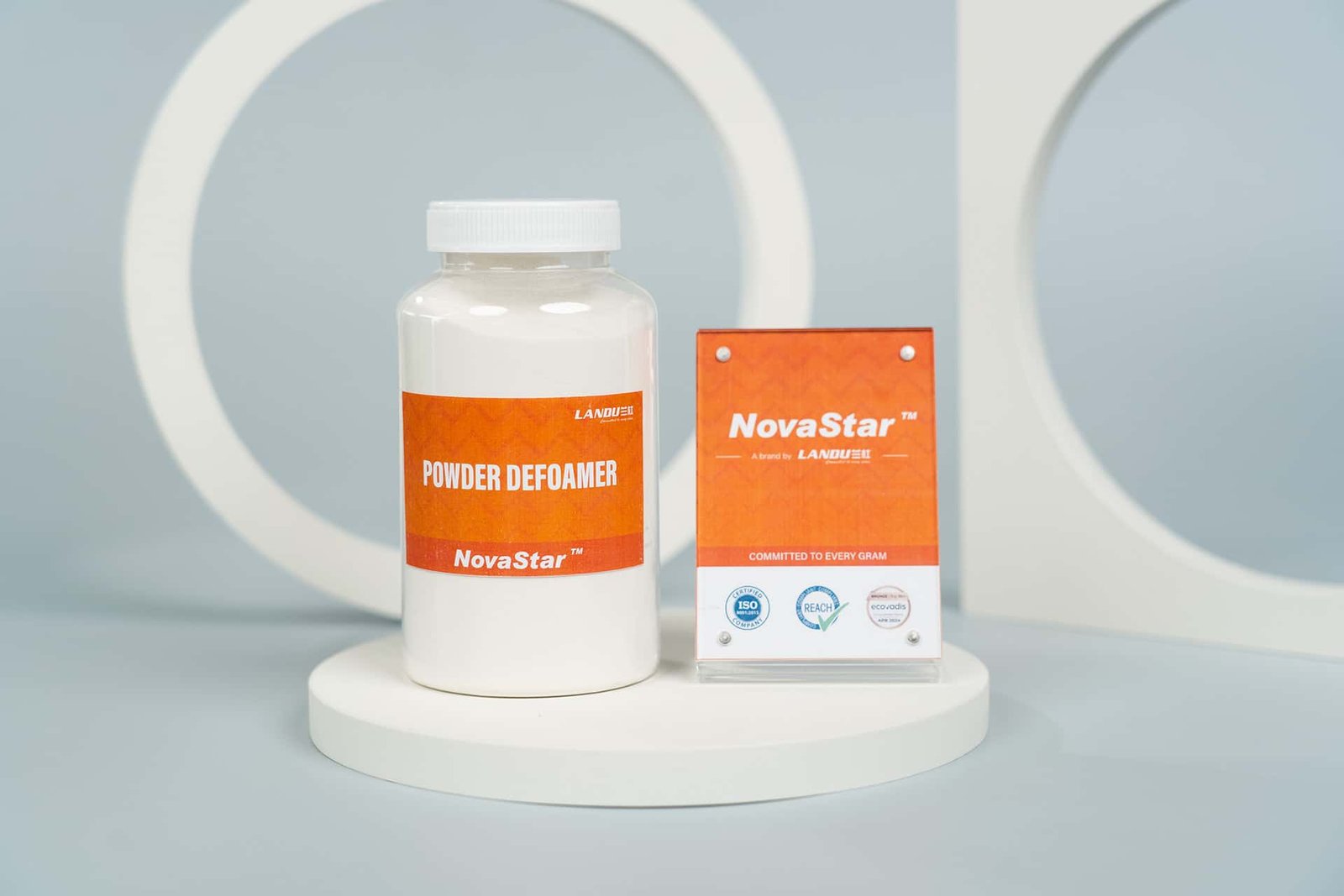
Which NOVASTAR grade is suitable for an alkaline cementitious self-leveling mortar?
P805 is the published starting option for alkaline systems. Compare it against the control at the application’s actual water temperature, PCE level and mixing conditions; request current TDS for grade-specific limitations.
Can P807 be used in cold-weather construction products?
P807 is listed by LANDU for low-temperature environments. Its effectiveness at a specific temperature is not established by the published reference alone, so confirm the temperature range and run practical trials before specifying it.
How much powder defoamer should be added to mortar?
The original LANDU page lists 0.1–0.3% as a dosage reference for all three grades, but does not specify the denominator or test system. Confirm the basis of this percentage and establish the appropriate level by application-specific dose-response trials.
Can excessive defoamer cause application problems?
Yes. Unnecessary air removal or incompatible defoamer selection may change flow, destabilize a mixture or impair the finish. Test minimum effective dosage along with wet density, spread, bleeding and any relevant downstream properties.
Is powder defoamer a substitute for PCE, HPMC or RDP?
No. Defoamers address excessive entrained air. PCE primarily modifies dispersion and flow, cellulose ethers help control rheology and water movement, and RDP contributes polymer modification. These functions can interact but are not interchangeable.
What information should be included in a technical inquiry?
Specify target mortar application, binder/filler system, other admixtures, mixing method, temperature, observed foam-related issue, current dosage and desired test result. This makes grade recommendations and sample evaluation more relevant.