
NOVASTAR™ / CONSTRUCTION ADDITIVES

Gypsum Retarder P300 / P400

Setting-time control additives for gypsum plaster, gypsum putty, jointing compounds and compatible gypsum-based self-leveling systems. Evaluate the right working-time window without overlooking hardening schedules and finished-product strength.

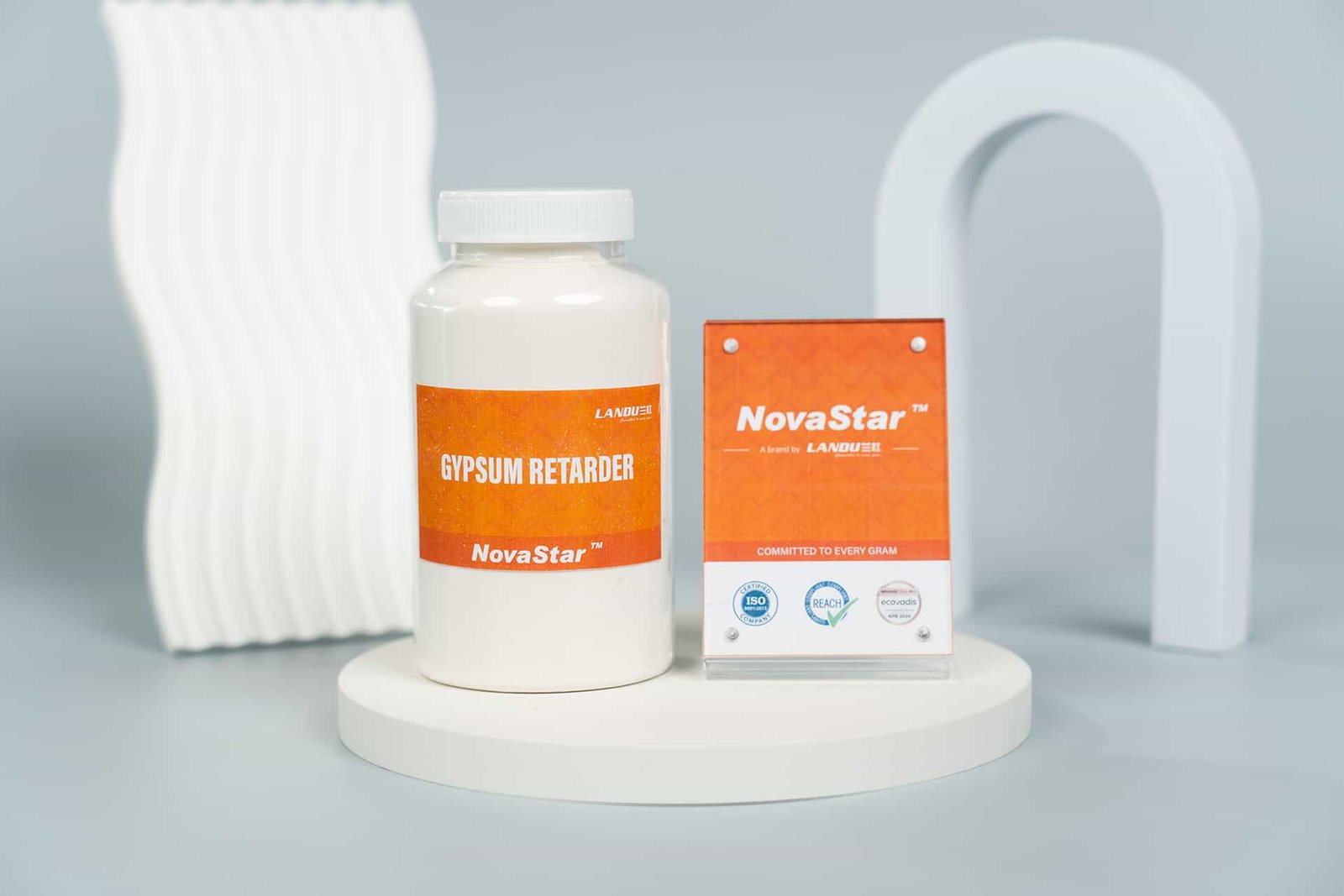
NOVASTAR gypsum retarder product image from LANDU media library
P300 / P400Grade-specific selection and evaluation
PRODUCT INFORMATION

What Is NOVASTAR™ Gypsum Retarder?

A gypsum retarder is a functional additive used to delay setting in compatible calcium sulfate binder formulations. NOVASTAR™ P300 and P400 are product options for manufacturers who must coordinate mixing, transport, application and finishing with a predictable hardening schedule.

Primary functionGypsum setting-time control
Available gradesNOVASTAR™ P300 / P400
Product formDry-mix additive powder
Typical binderCalcium sulfate hemihydrate
Worker applying gypsum plaster with a spatula on a wall
Gypsum plaster installation — setting-time control helps coordinate spreading and finishing.

Technical Information

Use the specific P300 or P400 Technical Data Sheet for the authoritative numerical specifications and dosing recommendations.

Brand / productNOVASTAR™ Gypsum Retarder / LANDU
GradesP300 and P400
FunctionDelay the onset and progression of gypsum setting
Primary applicationsGypsum plaster, putty, jointing compounds, selected gypsum self-leveling mixes
Addition and incorporationUniform dry blending; grade-specific trial dosage required
Numeric specificationsRefer to the latest approved grade-specific TDS
Packaging25 kg bags; confirm shipment configuration
Important distinction: A gypsum retarder is not a cellulose ether. It primarily changes the setting profile; it does not independently guarantee water retention, sag resistance, adhesion, crack resistance or final-product certification.
MATERIALS SCIENCE

How Gypsum Retarder Works During Hydration

In conventional hemihydrate-based gypsum, setting develops as calcium sulfate hemihydrate dissolves and calcium sulfate dihydrate crystallizes. The interlocking dihydrate crystal network progressively gives the material rigidity.

CaSO₄·½H₂O + 1½H₂O → CaSO₄·2H₂OCalcium sulfate hemihydrate + water → calcium sulfate dihydrate
STEP 01

Dissolution

Hemihydrate dissolves and releases calcium- and sulfate-containing species into the mixing water.

STEP 02

Nucleation & crystal growth

When the liquid becomes supersaturated with respect to dihydrate, new crystals form and grow.

STEP 03

Setting and hardening

Crystal intergrowth reduces mobility and builds the solid structure responsible for hardening.

How organic retarders influence setting

Published research on amino-acid and other organic gypsum retarders indicates that interactions with calcium-containing species and growing dihydrate crystal surfaces can affect nucleation and crystal-growth kinetics. Depending on formulation conditions, these changes delay the development of a load-bearing crystal network.

A chemical mechanism reported for a class of additives is not proof that every NOVASTAR grade operates identically. Binder-specific trials are needed to establish actual dose response, setting behavior and strength development.

The engineering objective is a usable application window and acceptable subsequent hardening—not the longest setting delay possible.

Retarder vs. Cellulose Ether vs. PCE

Gypsum retarderSetting-time control
HPMC / HEMCWater retention and rheology adjustment
Compatible PCEDispersion and water reduction
Powder defoamerAir management in compatible dry mixes

These are different formulation functions. A slurry may lose flowability even before a setting-time test endpoint is reached; increasing the retarder level alone may not solve such a problem.

GRADE SELECTION

NOVASTAR™ P300 and P400: Application-Oriented Screening

The grades should be compared under the customer's gypsum chemistry, process temperature and practical workability requirements. The table identifies screening directions; it does not establish a universal difference in retarding efficiency or strength.

Request Grade Documentation ↗
Selection factorNOVASTAR™ P300NOVASTAR™ P400
Primary evaluation areaGypsum plaster, gypsum putty and setting-type jointing compoundsGypsum-based self-leveling and other compatible flowable gypsum formulations
Processing objectiveSpreading, filling and finishing timeMixing, pumping, transport, spreading and leveling time
Important measurementsWorking time; initial/final set; finishing; early hardeningFlow retention; segregation resistance; initial/final set; mechanical strength
Selection approachTrial the formulation using actual gypsum and co-additivesTrial the full gypsum/dispersant/rheology package

P300 — Plaster and finishing applications

Evaluate where installation teams need reliable spreading, joint filling and finishing time. The correct setting profile must also allow the finished plaster or joint compound to harden at an acceptable rate.

  • Hand-applied and machine-applied gypsum plaster
  • Gypsum putty and setting-type jointing products
  • Other compatible finishing systems after trials

P400 — Gypsum self-leveling applications

Evaluate when a pourable gypsum mix must remain placeable and levelable for the planned floor installation cycle. Setting-time control must be coordinated with dispersant performance and suspension stability.

  • Gypsum-based self-leveling underlayments
  • Other compatible flowable calcium sulfate formulations
  • Full-system flow, set and strength verification
Specification control: Use the latest approved P300/P400 TDS for appearance, moisture, density, chemistry, dosage guidance and storage data. Do not transfer values from unrelated cellulose ether products or historical supplier pages.
APPLICATIONS

Gypsum Retarder Applications by Production Process

Different gypsum products require different balances between working time, material stability, application method and subsequent hardening. Use the target formulation rather than a universal dosage assumption.

Worker manually spreading and finishing gypsum plaster on an interior wall
APPLICATION 01

Hand-Applied Gypsum Plaster

Control early stiffening so the plaster remains spreadable through leveling and final finishing. Excessive retardation can shift the hardening schedule and interfere with follow-on work.

Evaluate: workable finishing time, initial/final set, early strength

Plaster mixing and pumping machine used for machine-applied plaster
Representative plaster-pumping equipment; not a LANDU product.
APPLICATION 02

Machine-Applied Gypsum Plaster

Coordinate setting-time delay with mixer residence, hose transport, spraying and finishing. Laboratory setting tests alone cannot establish whether the product will remain pumpable.

Evaluate: pump behavior, consistency drift, working time
Worker finishing a gypsum board surface as an illustration of jointing operations
APPLICATION 03

Gypsum Putty & Jointing Compounds

Support joint filling, tape bedding and feathering time in setting-type materials while checking adhesion, shrinkage and hardening separately.

Evaluate: application window, finishing, hardened properties
Workers placing a self-leveling floor compound, illustrative of floor leveling processes; binder chemistry not verified
Illustrative floor-placement photo; binder type not confirmed.
APPLICATION 04

Gypsum-Based Self-Leveling

Coordinate the setting profile with flow retention, placement area and leveling time. A retarder does not replace a suitable dispersant or viscosity-control additive.

Evaluate: spread retention, segregation, set and strength
Craftsperson working with a plaster mold in a workshop; illustrative of gypsum mold preparation
Plaster mold-making process photo; not a LANDU facility.
APPLICATION 05

Precast & Molded Gypsum Products

Provide a workable mold-filling interval without disrupting demolding, production-cycle timing or early mechanical requirements.

Evaluate: filling time, demolding, early strength
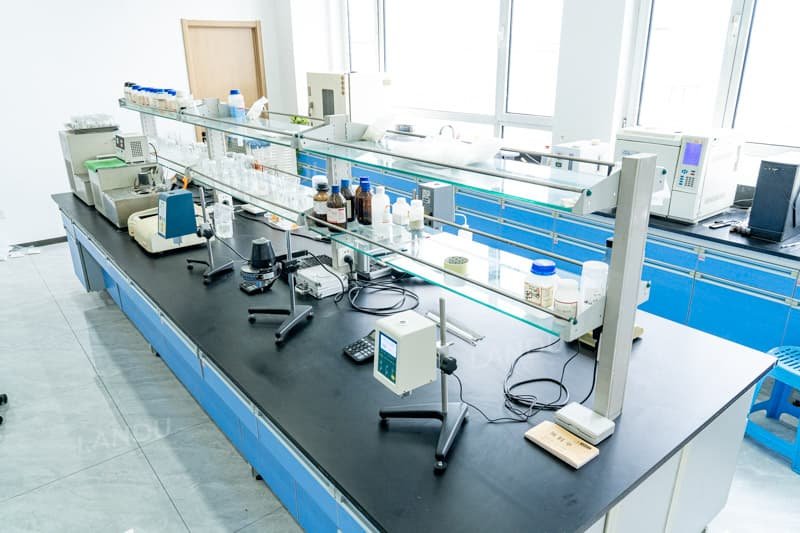
LANDU laboratory setting illustrating the importance of binder-specific comparative trials
PROCESS CONSIDERATION

Different Binders, Different Results

Alpha- and beta-hemihydrate, natural and synthetic gypsum sources, particle size and storage history can alter retarder demand and response.

Evaluate: source-specific response under controlled tests
Image credits: LANDU site media library (site application and laboratory images). Machine plastering image: Michel Pol / Wikimedia Commons, CC BY-SA 4.0. Plaster mold-making image: Coyau / Wikimedia Commons, CC BY-SA 3.0. These images illustrate production contexts, not NOVASTAR grade-performance testing or a LANDU gypsum manufacturing line.
FORMULATION ENGINEERING

Dosage Selection and Comparative Trials

Gypsum retarder response depends on binder source, hemihydrate type, fineness, water-to-binder ratio, temperature, residual dihydrate, other admixtures and actual mixing conditions. Begin with a current grade-specific TDS and specify the dosage mass basis.

01

Establish control

Measure the untreated mix at a consistent water/binder ratio, mixing time and material temperature.

02

Screen retarder

Trial documented addition levels with uniform dry blending. Compare P300/P400 as appropriate.

03

Check working time

Record setting endpoints and real application behavior: flow, pumpability or finishability.

04

Verify hardening

Assess early and later strength and the production timetable relative to the control.

LANDU construction-additive laboratory environment
LANDU laboratory — product evaluation discussions should be backed by recorded trial conditions.

What to record for meaningful comparisons

Gypsum source

Supplier, type, batch and relevant binder characterization.

Mixing conditions

Water ratio, dry-blend method, temperature and time.

Set and use window

Initial/final setting and the actual workable interval.

Hardened performance

Early and later strength, surface quality and curing.

Choose the setting-time and strength procedures appropriate to the target gypsum material. Report specimen preparation, water ratio, temperature and measured endpoints so comparisons remain meaningful.
Technical references: ASTM C472-26 (gypsum material test methods) · EN 13279-2 (gypsum binders and plasters test methods). These references describe general methods, not certified performance results for NOVASTAR P300 or P400.
PRACTICAL TROUBLESHOOTING

Diagnosing Gypsum Setting and Application Problems

Do not increase the retarder dose until the underlying cause of the failure is understood. Fresh-state rheology and chemical setting are related, but different, aspects of formulation performance.

ISSUE 01

Gypsum sets earlier than expected

Investigate: Binder reactivity, hot mixing water, insufficient retarder response, residual set gypsum or dosing variation.

Next step: Re-run the baseline at controlled temperature, then establish a dose–setting curve.

ISSUE 02

Hardening is excessively delayed

Investigate: High retarder level, changed binder batch and additive interactions.

Next step: Screen lower levels and verify acceptable hardening and mechanical properties.

ISSUE 03

Setting varies between production batches

Investigate: Premixing uniformity, gypsum moisture, source variation and temperature drift.

Next step: Standardize weighing, blending, sample conditioning and measurement.

ISSUE 04

Self-leveling slurry loses flow

Investigate: Early hydration versus dispersant insufficiency, water demand or rheological instability.

Next step: Separate spread-retention measurements from setting-time results.

ISSUE 05

Strength drops after retarder addition

Investigate: Retarder level, gypsum crystal development, water content and porosity.

Next step: Compare trials at similar useful setting times and consistent water/binder ratios.

ISSUE 06

Plaster finishes inconsistently

Investigate: Working time, water retention, viscosity profile, ambient drying and substrate suction.

Next step: Assess both retarder and cellulose ether roles; do not treat them as interchangeable.

TECHNICAL SUPPORT

From Product Selection to Controlled Validation

LANDU supplies functional construction additives. Gypsum retarder selection should be based on the customer's specific binder system, actual working process and commercial requirements.

Grade-specific documentation

Request the current P300/P400 TDS and relevant SDS before defining product specifications.

Application-focused discussion

Share the current and target setting times, gypsum type and complementary additives to narrow candidate grades.

Sample testing before scale-up

Confirm dose response, usable processing time and hardened performance before plant adoption.

Contact LANDU Technical Sales
LANDU laboratory facilities
TECHNICAL FAQ

Frequently Asked Questions

Answers for formulation engineers and gypsum construction-material manufacturers.

What does a gypsum retarder do?

It delays setting in compatible calcium sulfate systems, allowing additional time for mixing, placement or finishing. The aim is to meet a defined processing window while maintaining an acceptable hardening schedule.

What is the difference between NOVASTAR™ P300 and P400?

P300 is presented for screening in gypsum plaster, putty and setting-type jointing products; P400 is presented for gypsum-based self-leveling systems. Their suitability and optimal addition level must be confirmed with the target gypsum and other additives. The application categories do not prove a fixed difference in retarding strength.

What is the recommended gypsum retarder dosage?

Use the current grade-specific TDS as the starting point and clarify whether the percentage is calculated on gypsum-binder mass or total dry mix. Determine the working dosage using controlled trials with the intended gypsum source.

Can gypsum retarders affect compressive or flexural strength?

Yes. The effect depends on additive chemistry, dosage, gypsum source, water ratio and crystal development. Compare hardened performance alongside setting time and processability; avoid assuming that longer working time is always better.

Can gypsum retarder be combined with HPMC or PCE?

Suitable combinations can be evaluated. Retarder primarily adjusts setting behavior, cellulose ether supports water retention and rheology, and compatible PCE supports dispersion. Verify the complete additive package rather than extrapolating from single-additive tests.

Are initial setting time and working time the same?

No. Initial setting time is defined by a chosen test procedure, while working time describes how long the mixture remains usable for its intended activity. A formulation can lose practical flowability or finishability before the standardized setting endpoint.

Can gypsum retarder be used in cement-based tile adhesives?

Do not assume suitability. This product page addresses gypsum-based calcium sulfate formulations. Cement-based systems have different hydration chemistry and require separately validated admixtures.

COMPLEMENTARY PRODUCTS

Explore other functional materials that may be used in appropriately designed gypsum systems. The additives perform different roles and must be validated together.

REQUEST A RECOMMENDATION

Find the Right Setting Window for Your Gypsum Product

Tell LANDU your gypsum source, application, current and target setting times, water-to-binder ratio and other additives. This helps identify a useful P300/P400 sample-screening route.

For commercial inquiries, include estimated demand and destination country. LANDU supplies additives—not a complete dry-mix system or guaranteed finished-product performance.